In today’s competitive landscape, B2B digital marketing is more than just online presence—it’s about building trust, generating qualified leads, and driving long-term growth. Businesses must adopt data-driven strategies, personalized content, and multi-channel approaches to stay ahead. From SEO and content marketing to LinkedIn outreach and email automation, the right mix can transform how companies attract and convert clients. A strong digital strategy ensures consistent visibility and measurable results.
What is B2B digital marketing and why the old playbook is broken
Let’s start simple. B2B marketing — short for business-to-business marketing — is when one company sells to another company instead of to regular customers. Think of a software company selling tools to a hospital, or an agency selling ad services to a retailer. That’s B2B.
The digital side just means doing all of that online — through search engines, emails, social media, content, and ads. And when you combine both? You get B2B digital marketing strategies that help businesses find new clients, build trust, and close deals without cold calling everyone in their contact list.
Here’s the thing though. What worked 5 years ago? Mostly dead. You used to be able to post a blog, share it on LinkedIn, and watch the leads roll in. Today, that same post might reach 1.6% of your followers. Yes — 1.6%. That’s like throwing a party and only 1 person showing up out of every 60 you invited.
How does the B2B buying journey actually work in 2026?
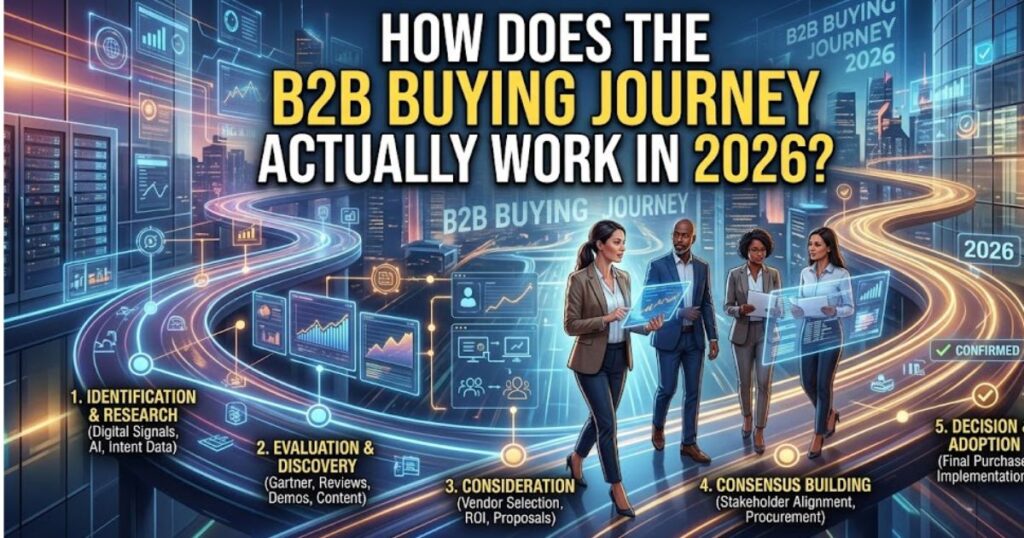
Picture this. Someone at a mid-sized company in Chicago realises their current software is slowing them down. What do they do? They don’t call a sales rep. They Google it. They read reviews. They watch a YouTube video. They ask a colleague. They check Reddit. And they do all of this — quietly, privately — before your sales team even knows they exist.
That’s the B2B buyer journey in 2026. It’s not a straight line. It jumps forward, loops back, pauses for months, then suddenly accelerates. And here’s the kicker — buying decisions are rarely made by one person. The average B2B purchase now involves more than 11 different stakeholders. That means your content needs to speak to the finance person, the IT manager, the end user, and the CEO — sometimes all at once.
The companies that win are the ones that show up at every single stage of that journey with the right content at the right time. Not just at the bottom when someone’s ready to buy — but at the very top, when they’re just starting to realise they have a problem.
The 10 B2B digital marketing strategies that actually drive growth
Right. Let’s get into the meat of it. These are the 10 B2B digital marketing strategies that US companies are using right now to fill their pipelines, shorten their sales cycles, and grow revenue that compounds over time.
B2B SEO strategy — Organic search is still the single lowest cost-per-lead channel available. 33% of B2B companies say it’s their top lead generator. Invest here, and it pays you back for years.
B2B content marketing — Useful blog posts, white papers, and case studies build your credibility over time. 91% of B2B marketers use content marketing. The ones who win use it with a clear strategy.
Account-based marketing (ABM) — Instead of casting a wide net, you pick your 50 dream clients and go all-in on them. Personalised emails, targeted ads, custom landing pages — the works.
B2B email marketing strategy — Email still delivers one of the highest returns of any channel. The secret? Behaviour-based automation. Send the right message when someone actually does something, not just on a Tuesday.
LinkedIn marketing — For B2B companies, LinkedIn is the playground where your buyers actually hang out. Use it for thought leadership, targeted ads, and direct conversations with decision-makers.
B2B PPC strategy — Paid search on Google captures buyers at the exact moment they’re looking for what you offer. It’s fast, measurable, and brilliant for bottom-of-funnel leads.
B2B video marketing — Nearly 70% of B2B marketers are increasing their video spend. Explainer videos, webinars, and customer stories build trust faster than any written page.
Marketing automation — Stop doing repetitive tasks by hand. Automation tools handle lead nurturing, email sequences, and follow-ups so your team can focus on strategy.
First-party data strategy — With third-party cookies disappearing, companies that own their data will win. Build your email list. Grow your CRM. Protect it like gold.
Employee advocacy — Your team’s personal LinkedIn posts reach 10x more people than your company page. Give your colleagues the tools and confidence to share their expertise publicly.
Answer engine optimisation: the strategy your competitors are ignoring
Have you noticed that when you type a question into Google these days, you sometimes get a full answer right there — without clicking anything? That’s an AI Overview. And it’s changing everything.
More and more people are now using ChatGPT, Perplexity, and Google’s AI features to research products and services before buying. This means your content doesn’t just need to rank in search results — it needs to be the answer that AI tools serve up when a buyer asks a question.
This is called Answer Engine Optimisation, or AEO. And right now, barely any of your competitors are doing it properly. That’s your window.
How to do it
Write content that directly answers specific questions. Use clear headings. Give concise, factual answers in the first 2–3 sentences of each section. Structure your pages the way a helpful teacher would explain something to a curious student.
Zero-click content — content designed to give so much value upfront that people trust your brand even without visiting your site — is the companion strategy here. It sounds counterintuitive. But the more helpful you are, the more authority you build, and the more likely someone is to come back and buy.
Account-based marketing deep dive: how to win the clients you actually want
If you’re serious about B2B digital marketing strategies for high-value clients, account-based marketing is one of the most powerful moves in your toolkit. Think of it this way — instead of fishing with a huge net and hoping for the best, ABM is more like fishing with a spear. You know exactly which fish you want, and you go after it with everything you’ve got.
ABM works brilliantly for US companies selling complex, expensive solutions to enterprise buyers. Why? Because one enterprise deal can be worth more than 50 smaller ones. The maths makes ABM worth every minute of effort.
Here’s how it works in practice. First, you build your Ideal Customer Profile — a detailed description of the exact kind of company that gets the most value from what you offer. Then you create a target account list. Maybe it’s 30 companies, maybe it’s 200. You research each one, understand their challenges, and build marketing experiences that feel completely personal to them.
The next level is called Account-Based Experience, or ABX. This takes ABM a step further by making every single touchpoint — your website, your emails, your ads, your sales conversations — feel like they were built for that one account. When done well, buyers feel genuinely understood. And that feeling? That’s what closes deals.
AI and automation: smarter B2B marketing without burning out your team
Artificial intelligence is no longer a shiny toy for tech giants. In 2026, 57% of US B2B teams are already using AI tools in their day-to-day marketing work. And the ones using it smartly are seeing 10 to 20% lifts in lead generation.
Here’s where AI is making the biggest difference right now. Campaign messaging — AI can write first drafts in seconds, freeing your team to refine and improve rather than starting from scratch. Predictive analytics — AI spots which prospects are most likely to buy before they’ve raised their hand. And personalisation at scale — delivering content that feels tailor-made to each buyer, even when you’re reaching thousands of them at once.
- Use AI to speed up content production — then have a real human review every piece before it goes out
- Let predictive analytics tell your sales team who to call today — not who you called last quarter
- Automate your lead nurturing sequences so no warm prospect ever falls through the cracks
- Always keep a human in charge of strategy, brand voice, and customer relationships
The golden rule? AI should make your team faster. It should never replace the empathy, creativity, and strategic judgement that only humans bring.
First-party data and cookieless targeting: your new competitive edge
Here’s a reality check. Third-party cookies — those little tracking tools that helped advertisers follow people around the internet — are on their way out. For a lot of B2B digital marketing strategies that relied on rented audiences and third-party lists, that’s a problem. For the companies building their own data? It’s an enormous opportunity.
First-party data is information you collect directly from your audience — email sign-ups, form fills, website behaviour, webinar registrations. Zero-party data goes one step further — it’s information your audience willingly shares with you, like survey answers or preference settings. Both are gold.
Your email list, CRM, website, and content library are your owned channels. Treat them as your most valuable business assets — because in a world without cookies, they genuinely are.
Sales and marketing alignment: the revenue multiplier hiding in plain sight
Here’s something that will either make you nod knowingly or sting a little. At most B2B companies, marketing and sales operate like two teams playing different sports on the same field. Marketing generates leads. Sales ignores them and calls it “low quality.” Sound familiar?
Companies that fix this alignment problem grow 19% faster and are 15% more profitable, according to Forrester. That’s not a small improvement — that’s business-transforming.
The fix starts with shared language. Both teams should agree on exactly what a “qualified lead” looks like. Then come shared metrics — both teams measured against pipeline generated and revenue closed, not just their own departmental numbers. Finally, a joint Revenue Operations framework (RevOps) ties everything together so marketing and sales are genuinely pulling in the same direction.
Is your B2B digital marketing strategy actually working? Measuring what matters
You can run beautiful campaigns and produce brilliant content — but if you’re not measuring the right things, you genuinely have no idea whether any of it is working. Here are the 5 metrics that actually matter for B2B growth.
Pipeline generated — How much revenue opportunity did marketing create this quarter?
Customer acquisition cost (CAC) — How much are you spending to win each new client?
Lead-to-close conversion rate — Of all the leads you get, how many become paying customers?
CAC payback period — How long before a new customer’s revenue covers what you spent to acquire them?
Customer lifetime value (CLV) — How much is the average client worth to your business over time?
Attribution is the hardest part of B2B measurement. Because the journey is so long and involves so many touches, giving credit to the right marketing activity is genuinely tricky. Multi-touch attribution models — especially W-shaped and time-decay models — give you a fairer picture of what’s actually driving revenue.
Conclusion
B2B digital marketing is essential for sustainable business growth in the modern era. By leveraging the right strategies and tools, companies can build strong relationships, increase brand visibility, and drive consistent revenue. The key lies in understanding your audience, delivering value, and continuously optimizing your efforts. A well-executed digital marketing plan can set your business apart in a crowded marketplace.
FAQs
What is B2B digital marketing?
B2B digital marketing refers to strategies used by businesses to promote their products or services to other businesses online. It includes SEO, content marketing, email campaigns, social media marketing, and paid advertising. The goal is to generate leads, nurture relationships, and convert prospects into long-term clients. Unlike B2C, it focuses more on logic, ROI, and building trust.
Which digital marketing channels work best for B2B?
The most effective channels include LinkedIn marketing, search engine optimization (SEO), email marketing, and content marketing such as blogs and whitepapers. Paid ads like Google Ads also help target decision-makers. The key is to use a mix of channels tailored to your audience and track performance to optimize results.
How can B2B businesses generate more leads online?
B2B businesses can generate leads by creating high-quality content, optimizing their website for SEO, using lead magnets (like eBooks), and running targeted ad campaigns. Email marketing and CRM tools help nurture leads over time. Consistent engagement and providing value are essential for converting prospects into clients.