Your audience is searching to make sure they find you first. Our proven SEO marketing strategies help your business rank higher, attract quality traffic, and turn clicks into customers. With a perfect balance of data, creativity, and strategy, we focus on building long-term visibility and measurable growth. From keyword research and content optimization to link building and analytics, every step is designed to drive real results. Grow smarter, not harder, with SEO that turns visibility into lasting success.
What Do Searchers Really Want? Decode Intent Before You Write
The best SEO marketing strategies for 2025 start with one simple question: what does the person searching actually want? Before you even think about keyword research or writing a single word, you need to understand their search intent. It’s the secret behind why some pages rank and others don’t. Think of it like being a mind reader for your audience.
From Information to Action
Search intent falls into 4 main types. Someone might want to learn something (informational), find a specific website (navigational), buy something now (transactional), or compare options before buying (commercial). Figuring this out tells you if you should create a how-to guide, a product page, or a comparison chart. This simple step is the foundation for every other part of your SEO strategy, from on-page SEO to your content refresh plan.
How do I choose a single angle for mixed-intent keywords?
Sometimes, a keyword has a mix of intentions. If someone searches for “best running shoes,” they might want to see reviews, find a local store, or buy online. To pick your angle, look at the top search results. Do you see lots of review articles? E-commerce pages? That’s your clue! Google is showing you what it believes most people want. Matching that dominant intent is your clearest path to success.
Build Topical Authority, Not One-Off Posts
A winning SEO marketing strategy isn’t about writing random blog posts. Imagine trying to become a famous chef by making one great pizza. It’s a good start, but it doesn’t make you an expert on all food. To show Google you’re a true authority, you need to cover a whole topic, not just one keyword. This is called building topical authority, and it’s one of the best SEO strategies for 2025. When you’re seen as the go-to source, Google trusts you more and shows your content to more people, helping you win featured snippets and spots in AI Overviews.
Pillars, Clusters, and Smart Connections
Think of your main subject as a big “pillar page.” This is a long, detailed guide covering the most important parts of your topic. Then, create smaller “cluster” posts that dive deeper into specific parts of that pillar. For “local SEO,” your pillar page might cover everything, while your cluster posts could be about “Google Business Profile optimization” or “how to get local reviews.”
The magic happens when you connect them all with internal linking. Your pillar page should link out to every cluster post, and every cluster post should link back to the pillar. This simple internal linking map shows search engines how all your content is related, boosting your entire topic’s visibility. It creates a great user experience, lowering your bounce rate and increasing dwell time.
Show Google Who You Are with E-E-A-T
Building trust is huge. This is where E-E-A-T (Experience, Expertise, Authoritativeness, and Trustworthiness) comes in. You can signal this trust in a few easy ways:
- Create an “About Us” page: Clearly state who you are and what your business does. This helps Google understand your organization as a real-world entity.
- Use author bios: Add a short bio to each post showing who wrote it and why they’re an expert.
- Link to your sources: When you mention a fact or statistic, link to the original source. It shows you’ve done your homework.
By connecting your content into topic clusters and proving your expertise, you tell search engines you’re not just a one-hit wonder. You’re a reliable authority, ready to answer any question a user might have. This strong foundation makes every other part of your SEO strategy, from on-page SEO to link building, work even better.
On-Page SEO That Wins Zero-Click and Clicks
Think of your webpage as a friendly conversation with both your reader and Google. Great on-page SEO is about making that conversation as clear and helpful as possible. The goal is to answer questions so well that you sometimes show up in zero-click search results like featured snippets or AI Overviews, but also make people curious enough to click for more. This balance is key to the best SEO marketing strategies in 2025.
Answer First, Then Explain More
Start your articles with an “answer-first intro.” In the first 100-150 words, give a direct, simple answer to the main question. This helps search engines quickly understand your page and gives readers instant value. Then, use clear H2 and H3 headings to break down your content. This lets people easily scan and find what they need, which improves user experience signals like dwell time and lowers your bounce rate. Adding a table of contents with jump links is another fantastic way to help readers navigate.
Make Your Page Pop in Search Results
Your title tag and meta description are like your storefront in the search results they need to be inviting! A great title grabs attention, while the meta description gives a sneak peek of the awesome information inside. This is your first chance to win the click. Inside your content, cover the topic completely by including related ideas and answering common questions, which you can find in the “People also ask” section on Google.
Don’t Forget the Pictures and Connections
Even your images need an SEO strategy! Giving your pictures simple, descriptive names and adding alt text helps search engines “see” what they are. This is a quick win for image SEO. Finally, use internal linking to guide readers to other useful pages on your site. This strengthens your SEO marketing strategy by showing how your content is connected and keeping people engaged longer. These small on-page tweaks make a huge difference in how you rank.
SEO Marketing Strategies That Drive Real Results
Optimize for AI Overviews and Zero-Click Realities
Have you ever Googled something and gotten the answer right at the top, without needing to click a single link? That’s a zero-click search, and with new features like AI Overviews, it’s happening more often. This is a huge part of the best SEO marketing strategies for 2025. Your goal is to show up in these answer boxes while still making people want to visit your site. It sounds tricky, but it’s totally doable!
How to Format Your Content for AI and Snippets
The secret is to make your content incredibly easy for search engines to understand. Think of it as spoon-feeding them the exact answers they need. Start with an answer-first intro that directly addresses the user’s search intent. Use clear headings and short, scannable lists or numbered steps. This formatting is perfect for winning featured snippets and getting cited in AI Overviews. It also helps your content get found through voice search.
Another powerful tool is schema markup. Adding simple code like FAQ schema or HowTo schema gives search engines a labeled-up version of your content, making it even easier for them to feature you. By answering questions from the “People also ask” section directly in your content, you show that you’re a helpful resource, which builds trust and supports your E-E-A-T.
Will optimizing for AI Overviews hurt my CTR?
That’s the big question! It’s all about balance. Getting featured in an AI Overview is like getting free digital PR it boosts your brand’s authority. While the user gets a quick answer, you can still win the click by making them curious. After giving a direct answer, use smart internal linking to invite them to learn more. For example, you could say, “While that’s the quick answer, our full guide breaks down three more advanced steps.” This improves user experience signals like dwell time and shows you have even more value to offer.
Here are 3 simple steps to get started:
- Write a direct, one-paragraph answer at the top of your most important pages.
- Use numbered or bulleted lists for any how-to steps.
- Turn common questions into H2 or H3 headings.
This approach ensures you’re visible everywhere, giving you the best of both worlds: quick exposure and valuable website traffic.
Content Operations: Velocity, Refresh, and Pruning
A great SEO marketing strategy isn’t just about writing new things it’s also about taking care of what you already have. Think of your website like a garden. You need to plant new seeds, water your growing plants, and pull out the weeds. This process of managing your content is called content operations, and it’s essential for building long-term topical authority.
When to Update and When to Say Goodbye
Not every article you write will be a hit forever. Information gets old, and search rankings can drop. That’s where a content refresh comes in. If a post’s traffic is slipping, go back and update it with new information, better examples, and fresh keyword research. This tells Google the page is still valuable and helps you keep your spot in featured snippets and AI Overviews.
But what about posts that just aren’t working? This is where content pruning is your best friend. Keeping weak or outdated content can hurt your site’s overall quality.
Here’s a simple decision tree:
- Merge It: If you have two similar, weak articles, combine them into one strong one.
- Redirect It: If an old post is outdated but has good backlinks, redirect its URL to a newer, more relevant page.
- Delete It: If a post has no traffic, no backlinks, and adds no value, it’s okay to delete it.
Keeping Your Content Garden Healthy
Running a regular content audit helps you decide what to do. Once a quarter, look at your pages and ask these questions:
- Is the information still accurate?
- Is it getting any traffic?
- Does it still match the user’s search intent?
- Could the user experience be better?
By regularly refreshing and pruning your content, you improve important user experience signals like bounce rate and dwell time. This keeps your website healthy, trustworthy, and ready to rank, proving your E-E-A-T to both users and search engines.
Off-Page and Digital PR to Build Durable Authority
So far, we’ve focused on making your own website awesome. Now, let’s talk about what happens off your website. This is called off-page SEO, and it’s all about building a great reputation across the internet. Think of it like getting a gold star from other trusted websites. When other sites link to you or mention you, it sends strong brand signals to Google that you’re a big deal. This is a huge part of building durable E-E-A-T.
Earning Trust with Quality Backlinks
The most powerful off-page signal is a backlink, which is just a link from another website to yours. But not all links are created equal! The best SEO marketing strategies focus on earning high-quality links, not just getting as many as possible. Instead of trying tricks, the best approach is creating amazing content that people want to share.
Here are a few ways to earn great links:
- Create Original Research: Share interesting stats or a study you conducted.
- Make Helpful Tools: Build a simple calculator or checklist.
- Design Cool Data Visualizations: Turn boring numbers into a fun infographic.
Once you have something valuable, you can do friendly outreach to let other site owners know about it. At Bosthelp, we believe that creating genuinely helpful assets is the most honest and effective form of link building.
Don’t Forget Your Local Reputation
For businesses with a physical location, local SEO signals are incredibly important. Your Google Business Profile is your digital storefront. Getting positive reviews and ensuring your business information is correct on other sites (known as citations) builds massive trust. This social proof tells both potential customers and search engines that you are a legitimate and respected part of the community.
A simple plan for off-page authority:
- Do: Create content so good that others want to reference it.
- Don’t: Pay for spammy or low-quality links.
- Do: Ask happy customers for reviews on your Google Business Profile.
- Don’t: Forget that a great reputation offline helps your SEO online.
Building this off-page trust takes time, but it’s what separates a good SEO marketing strategy from a truly great one.
Local SEO for US Visibility
If your business serves customers in a specific area, local SEO is your secret weapon. It’s all about showing up when people nearby search for what you offer. Think of someone searching for “pizza near me.” Local SEO is what helps your pizza shop pop up first! It’s a vital part of any SEO marketing strategy because it connects you directly with customers who are ready to visit or buy.
Your Digital Storefront: Google Business Profile
Your most important tool for local SEO is your Google Business Profile. This is the free listing that appears in Google Maps and local search results. Think of it as your digital welcome mat. To make it shine, you need to fill it out completely.
- Services and Photos: Add your services and lots of high-quality photos to show people what you do.
- Posts and Q&A: Regularly share updates using Posts and answer questions in the Q&A section to stay engaged.
- Reviews: Encourage happy customers to leave reviews. Positive reviews are powerful user experience signals that build trust.
Be Consistent Everywhere
Imagine if your friend gave you three different addresses to their house. Confusing, right? It’s the same for Google. Your business Name, Address, and Phone number (NAP) must be identical everywhere online. This is called NAP consistency. When your info is consistent across different websites, known as local citations, it strengthens your credibility and builds topical authority for your location.
Create Awesome Location Pages
If you have a physical location, create a dedicated page for it on your website. This isn’t just any page that makes it super helpful! Include unique details about that specific spot, add an embedded map so people can easily find you, and link it back to your main topic clusters. This simple internal linking improves your site’s structure and helps users find what they need, reducing your bounce rate.
A quick local SEO checklist:
- Is your Google Business Profile 100% complete?
- Are you asking customers for reviews?
- Is your NAP consistent across the web?
- Does your website have a unique page for each location?
Getting these things right tells search engines you’re a trusted local player, ready to serve your community.
Measurement That Ties SEO to Pipeline
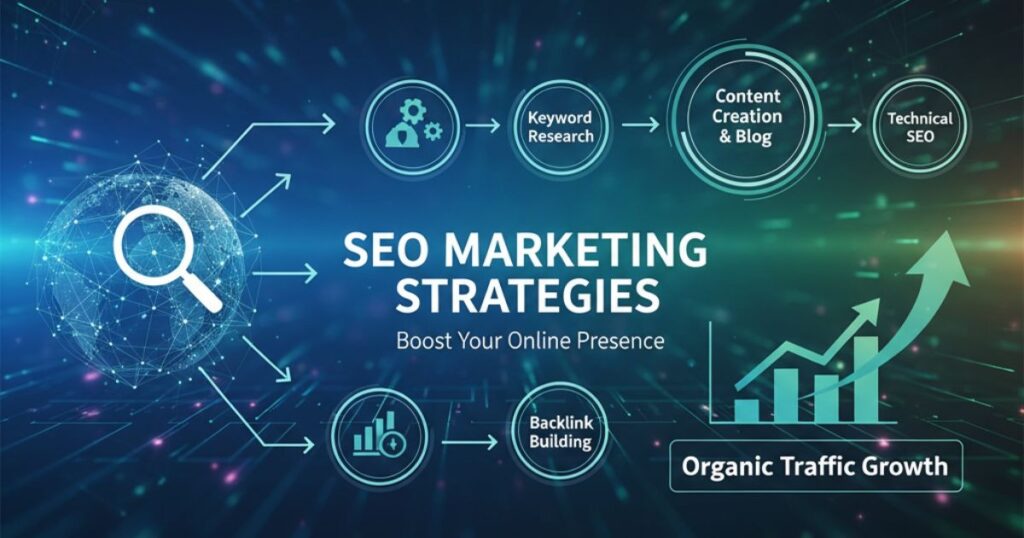
You’ve put in all this hard work so how do you know if your SEO marketing strategy is actually working? Measuring your success is more than just seeing traffic go up. It’s about connecting your efforts to real business results, like getting new customers. This is where you get to see the amazing impact of your work, turning clicks into cash.
From Impressions to Revenue: Following the Money
Think of your SEO journey as a simple path:
- Impressions: People see your page in search results.
- Clicks: They like what they see and click to visit your site.
- Leads: They fill out a form or contact you.
- Revenue: They become a paying customer!
Your job is to find out where people are dropping off this path and fix it. Tools like Google Search Console and Google Analytics 4 are your best friends here. They give you the data you need to make smart decisions.
What to Check and When
You don’t need to live inside your analytics. A quick check-in is all you need.
- Weekly: Look at GSC to find pages with high impressions but a low click-through rate (CTR). A simple title change could bring in a flood of new visitors!
- Monthly: Use GA4 to see which blog posts are bringing in the most leads. These are your superstars! See if you can improve them or create similar content. Also, look for pages that used to be popular but have lost traffic they might be ready for a content refresh.
Your Quick-Win Measurement Checklist:
A solid measurement plan doesn’t have to be complicated. Here’s a simple checklist to get started:
- Are you tracking impressions, clicks, and CTR in Google Search Console?
- Do you know which pages have the highest bounce rate?
- Can you identify your top 3 pages for generating leads in GA4?
- Have you found at least one page that needs a content refresh?
By keeping an eye on these numbers, you can prove that your SEO strategy is a powerful engine for growth, turning your hard work into real, measurable success.
Accessibility and Compliance for Better UX and SEO
A truly great SEO marketing strategy makes sure your website is welcoming to everyone. This is called accessibility, and it means designing your site so that people with disabilities can use it easily. Think of it like adding a ramp next to a staircase it opens the door for more people. The amazing part is that when you make your site more accessible for people, you also make it better for search engines.
Why Making Your Site Accessible Helps Your SEO
Search engines want to show their users the best, most helpful pages. An accessible site provides a fantastic user experience for all visitors, which sends great signals to Google. When people can navigate your site easily, they stay longer, which can improve dwell time and lower your bounce rate.
Many accessibility best practices overlap directly with on-page SEO and technical improvements. For example, using proper headings order (H1, then H2, then H3) helps people using screen readers understand your page structure, and it also helps Google understand your content hierarchy. Good image SEO, like writing descriptive alt text, helps visually impaired users know what an image is about, and it tells search engines the same thing!
Your Quick Accessibility Checklist
Making your site more inclusive doesn’t have to be complicated. Here are a few simple things you can do today:
- Add Alt Text to Images: Describe every image so screen readers can explain them.
- Check Your Headings: Make sure you use H1, H2, and H3s in a logical order.
- Use High Contrast Colors: Ensure your text is easy to read against its background.
- Test Keyboard Navigation: Can you get around your site using only the “Tab” key?
- Add Captions to Videos: Provide captions or transcripts for any video content.
By focusing on inclusive design, you’re not just doing the right thing for your audience, you’re also building a stronger, more resilient website. Better accessibility leads to happier users and better rankings, a true win-win.
Templates and Checklists to Power Your SEO Strategy
Reading about an SEO marketing strategy is one thing, but doing it is another! To make it easier, here are some simple templates and checklists you can copy and use right away. Think of them as your personal cheat sheets for getting things done.
Search Intent Snapshot
Before writing, quickly fill this out to stay focused.
- Main Keyword: According to topic
- What does the user want? (To learn, buy, find, or compare)
- What format will help them most? (A blog post, product page, or list)
- What are the top 3 results on Google doing?
Pillar and Cluster Map
Use this to plan your topic clusters and build authority.
- Pillar Page Topic: According to topic
- Cluster Post 1: (Links back to Pillar)
- Cluster Post 2: (Links back to Pillar)
- Cluster Post 3: (Links back to Pillar)
On-Page SEO Quick Checklist
Run through this list before you hit “publish.”
- Does the title tag grab attention?
- Does the meta description make you want to click?
- Is the main keyword in the first 100 words?
- Are there clear H2 and H3 headings?
- Did you answer questions from the “People also ask” section?
- Are there at least 2-3 internal links to other relevant pages?
Content Refresh Decision Notes
When auditing content, decide its fate.
- Page URL: According to topic
- Problem: (Traffic is down, info is old, etc.)
- Decision: (Refresh, Merge with another page, or Delete)
- Next Step: (Update stats, add new sections, redirect URL, etc.)
Local SEO Location Page Outline
For businesses with a physical address, a perfect local SEO page includes:
- Heading: City/Neighborhood Name + Main Service
- Content: Unique description of that location and what makes it special.
- NAP: Name, Address, Phone Number (must match your Google Business Profile).
- Map: An embedded Google Map.
- Reviews: A few quotes from happy local customers.
- Photos: Pictures of your local storefront and team.
Conclusion
In today’s competitive digital space, SEO isn’t just about ranking higher it’s about creating meaningful growth. By applying proven SEO marketing strategies, you can boost your visibility, attract the right audience, and convert clicks into loyal customers. From optimizing keywords to refining user experience, every step helps strengthen your brand’s online authority. The right strategy doesn’t just get you seen, it ensures your audience takes action.
FAQs
These include keyword optimization, link building, technical SEO, and content marketing techniques that consistently improve rankings and conversions.
SEO increases your site’s presence in search results, attracting qualified traffic that’s more likely to engage and convert.
Focus on high-quality content, mobile optimization, strong backlinks, and user-friendly site design to boost SEO results.
Typically, you’ll start noticing measurable improvements in 3 to 6 months with consistent and strategic optimization.
Absolutely. With the right local SEO, keyword targeting, and content strategy, small businesses can outperform big competitors online.